Governing Generative Music
Attribution Limits, Platform Incentives, and the Future of Creator Income
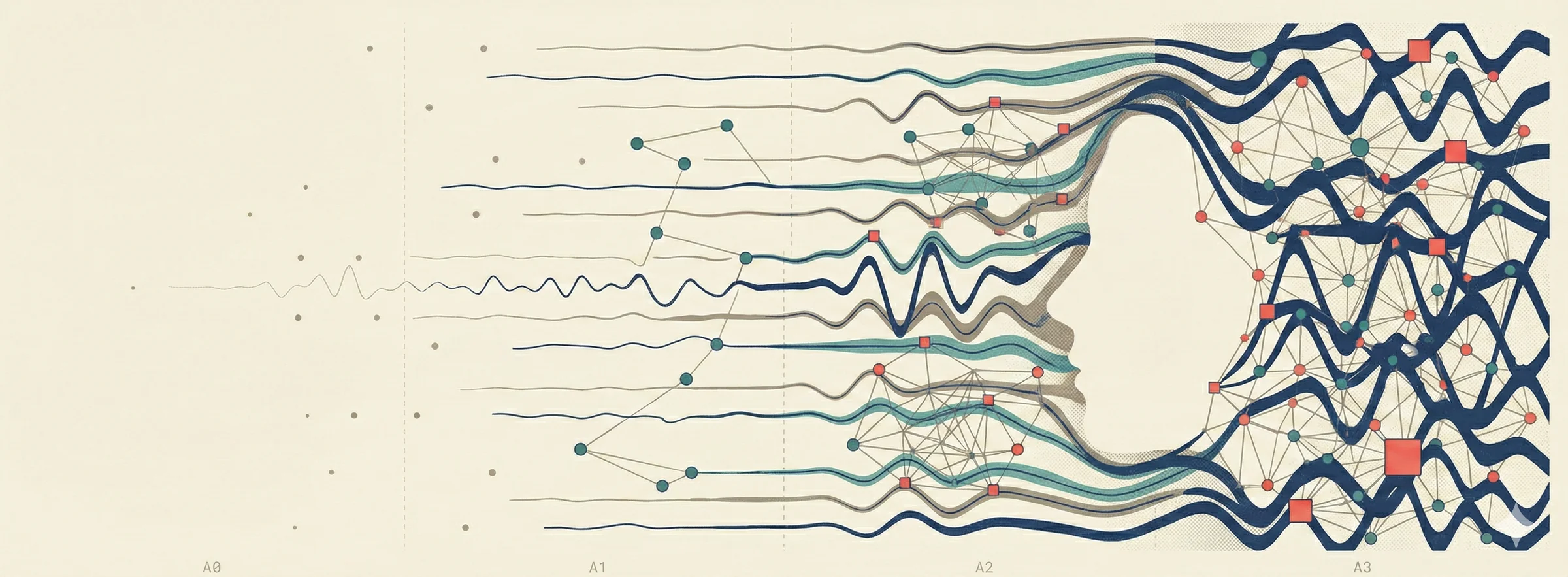
Your favourite song may have already trained the AI that will replace its creator. We propose a two-friction taxonomy, tiered attribution framework (A0–A3), and governance that functions despite imperfect attribution: contractible provenance, competitive licensing rails, and clear property rights.
How It Works
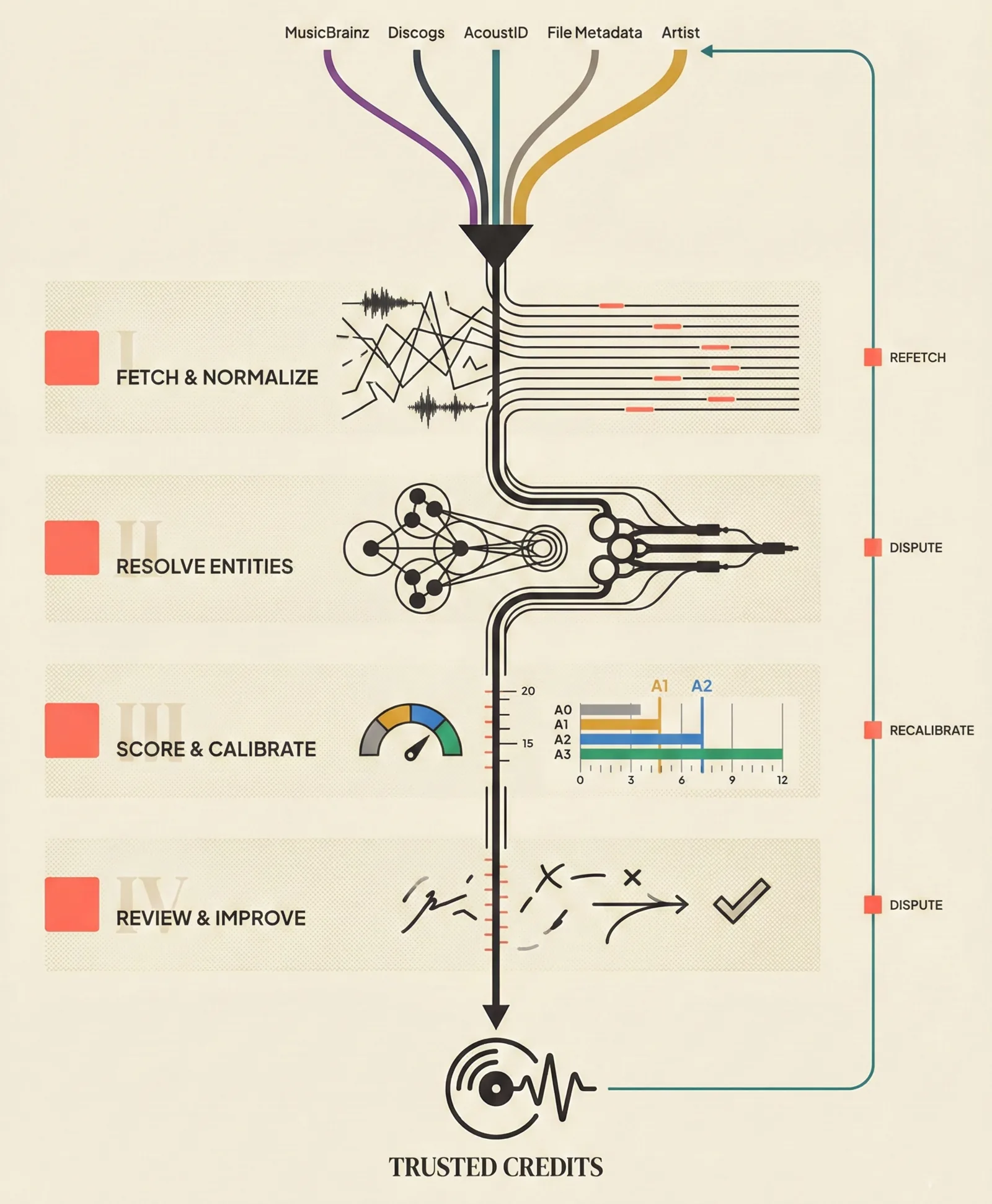
FETCH & NORMALIZE
ETL pipelines pull from MusicBrainz, Discogs, AcoustID, and file metadata into normalized records. [7]
RESOLVE ENTITIES
Entity resolution links records across sources using identifiers, string similarity, embeddings, and graph analysis. [18, 19]
SCORE & CALIBRATE
Attribution engine aggregates evidence, produces conformal prediction sets, and assigns calibrated confidence. [5, 6]
REVIEW & IMPROVE
Domain experts provide feedback via structured FeedbackCards. Confidence updates automatically through Bayesian calibration. [8, 20]
Key Concepts
Confidence & Uncertainty
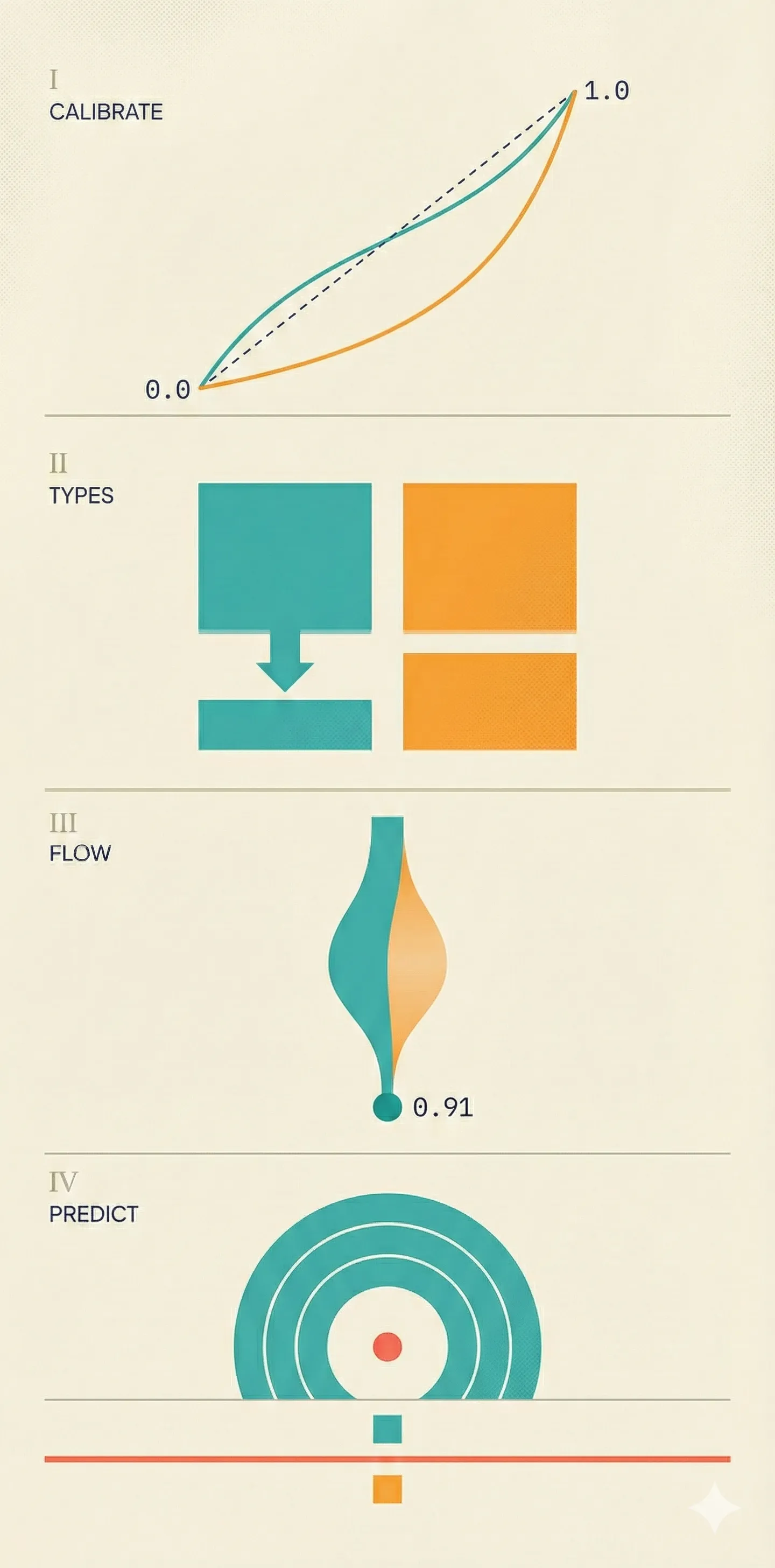
Calibrated Confidence
Every attribution comes with a calibrated confidence score. When the system says “90% confident,” the data is correct 90% of the time — a provable bound, not a heuristic. [1, 2]
Uncertainty vs. Confidence
Laypeople use “confidence” and “uncertainty” interchangeably, but they are distinct concepts. Confidence measures how certain a specific prediction is; uncertainty quantifies the range of possible outcomes. [3]
Uncertainty Propagation
When multiple uncertain estimates combine — ETL extraction, entity resolution, source corroboration — uncertainty must propagate correctly through the pipeline, not be lost at each stage. [4]
Conformal & Selective Prediction
Conformal prediction provides distribution-free coverage guarantees: the true value lies within the prediction set with probability 1−α. Combined with selective prediction, the system can abstain when uncertain. [5, 6]
Pipeline & Data
ETL Pipelines
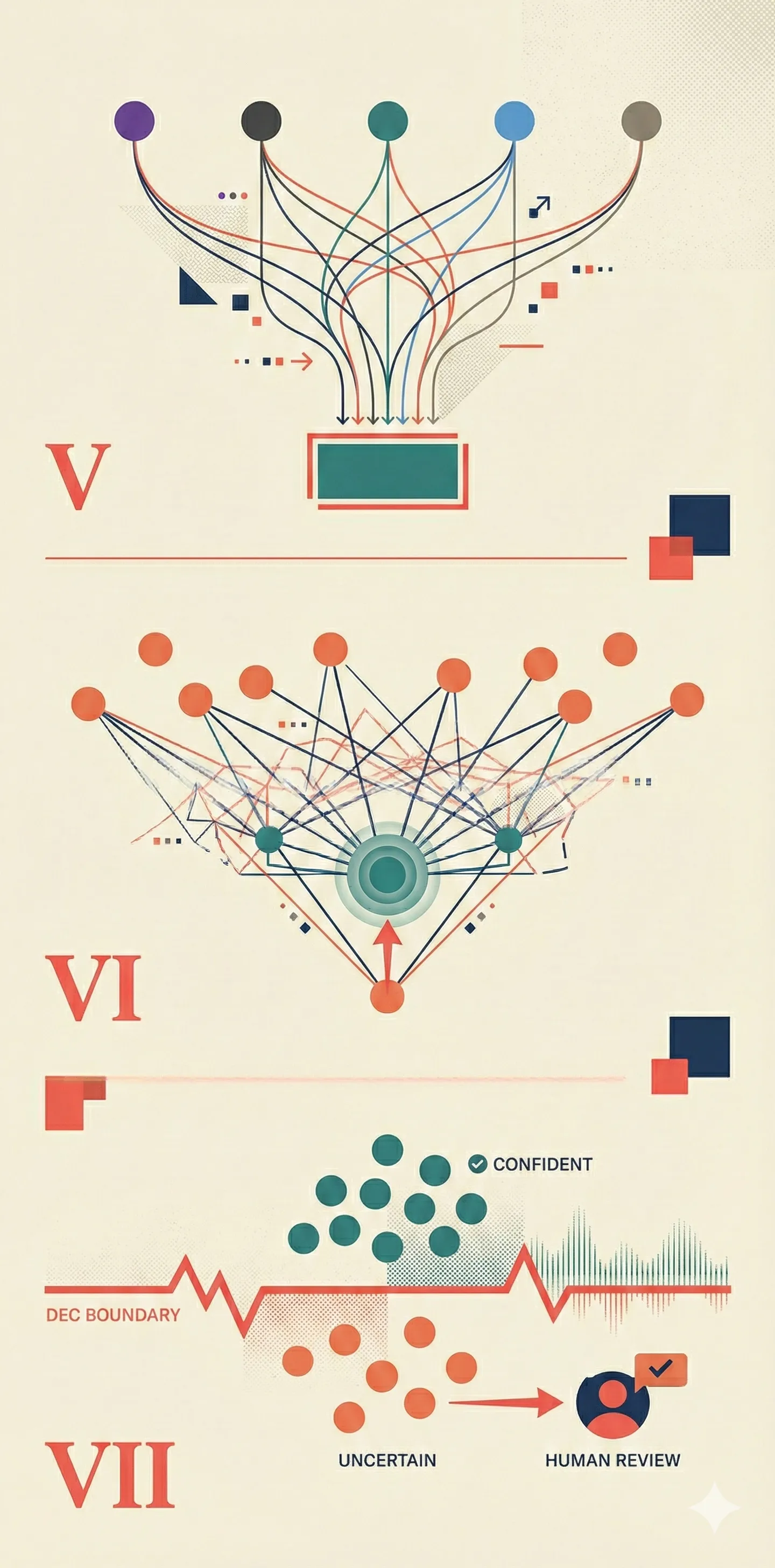
Real-world music metadata is fragmented across MusicBrainz, Discogs, AcoustID, streaming platforms, and file-embedded tags. ETL pipelines normalize these heterogeneous sources into a common schema. [7]
Entity Resolution
The same artist appears differently across databases — "Imogen Heap," "iMi," "Frou Frou," "I Megaphone." Entity resolution links these fragmented identities into a single resolved entity. [18, 19]
Active Learning & Feedback Cards
Instead of reviewing all attributions equally, active learning identifies the cases where human expertise adds the most value — low-confidence credits near the decision boundary. [8, 20]
Governance & Security
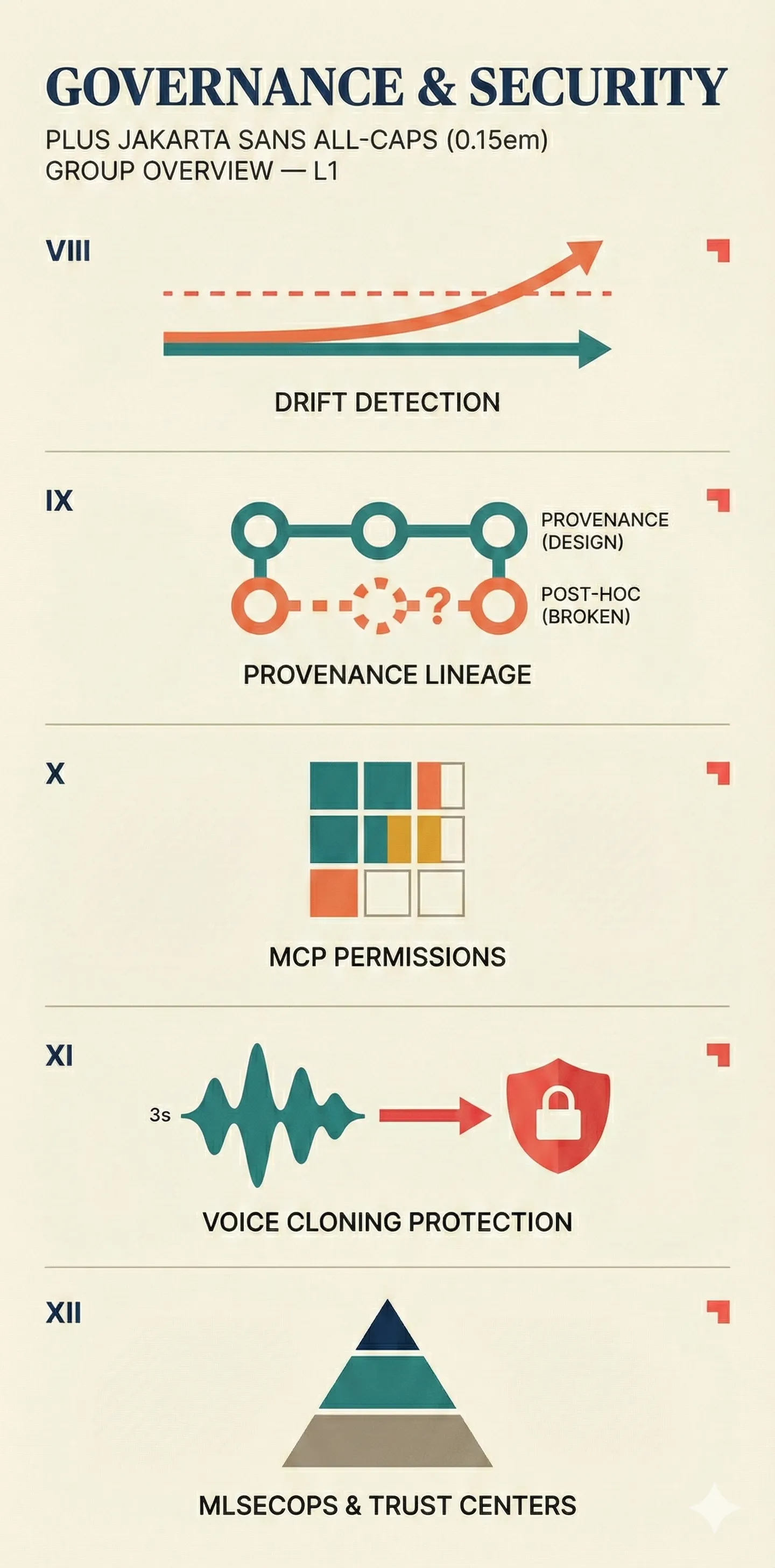
Drift Detection & Monitoring
Attribution models degrade over time as metadata conventions change, new sources emerge, and data quality fluctuates. Continuous monitoring detects these shifts before they affect users. [16, 17]
Provenance & Attribution-by-Design
Attribution-by-design embeds provenance at creation rather than computing it retrospectively. Every confidence-affecting event is recorded as an immutable audit entry. [9, 10]
MCP Permission Infrastructure
The Model Context Protocol provides machine-readable permission queries for AI training rights. When an AI system wants to use creative data, it must first query the artist’s permission settings. [11, 12]
Voice Cloning & Creator Protection
AI voice cloning can reproduce an artist’s vocal timbre from seconds of audio. This creates identity theft risks that traditional copyright cannot address — you cannot copyright a voice. [14, 15]
MLSecOps & Trust Centers
Enterprise-grade music attribution requires SOC2 compliance, multi-tenant data isolation, and customer-facing trust centers with real-time transparency on security posture. [21, 22]
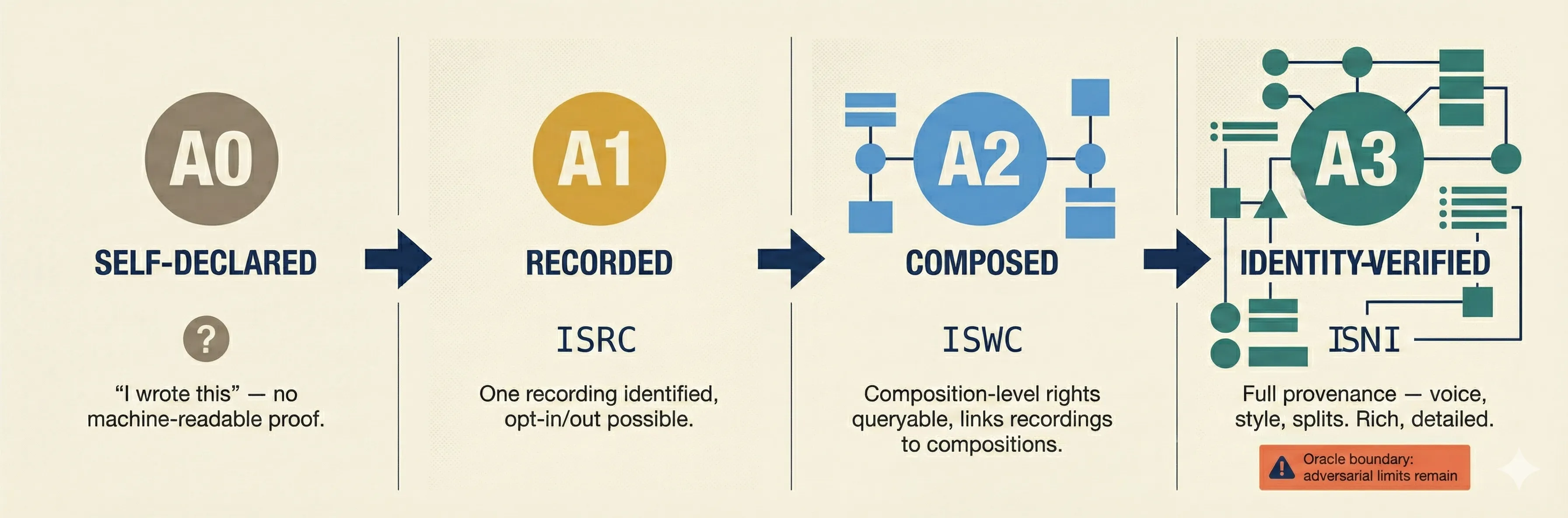
Assurance Levels
Attribution claims are stratified across four assurance levels, mapped to existing industry identifiers (ISRC, ISWC, ISNI). [12, 23, 24, 25]
| Level | Type | Evidence | Identifier |
|---|---|---|---|
| A0 | Self-declared | “I wrote this” | None |
| A1 | Recorded | ISRC assigned | ISRC |
| A2 | Composed | ISRC + ISWC linked | ISWC |
| A3 | Identity-verified | Full provenance chain | ISNI |
ISRC (International Standard Recording Code) identifies a specific audio recording. ISWC (International Standard Musical Work Code) identifies the underlying composition. ISNI (International Standard Name Identifier) identifies the creator themselves. Critical limitation: audio cannot reliably achieve A3 in adversarial settings due to the analogue hole.
Research Scaffold
Companion code to “Governing Generative Music” by Dr Petteri Teikari (SSRN No. 6109087). Transparent confidence scoring, provenance lineage, and MCP permission infrastructure working together.
The demo uses Imogen Heap's discography as example data — she pioneered music attribution through the Mycelia project in 2015, envisioning a fair-trade music ecosystem. That vision continues today with Auracles.io. Eight works showcase confidence ranging from 0% to 95%.
References
Stengel-Eskin, E. et al. (2025). “Calibrated Confidence for LLM Agents.” arXiv.
Tian, K. et al. (2025). “Confidence Calibration in Agentic Systems.” arXiv.
Beigi, M., Wang, S., Shen, Y. et al. (2024). “Rethinking the Uncertainty: A Critical Review and Analysis in the Era of Large Language Models.” arXiv.
Wang, Z. et al. (2025). “UProp: Uncertainty Propagation in LLM Agents.” arXiv.
Angelopoulos, A. & Bates, S. (2025). “Conformal Prediction for Uncertainty Quantification.” arXiv.
Quach, V. et al. (2024). “Conformal Prediction with Selective Prediction.” arXiv.
Narayan, A. et al. (2024). “Data Engineering Pipelines for Large-Scale Systems.” arXiv.
Monarch, R. (2023). “Human-in-the-Loop Machine Learning: Active Learning and Annotation.” arXiv.
Morreale, F. et al. (2025). “Attribution-by-Design: Inference-Time Provenance for Generative AI.” arXiv.
OpenLineage Project (2024). “Open Standard for Data Lineage.” OpenLineage.
Anthropic (2025). “Model Context Protocol Specification.” MCP.
Teikari, P. & Fuenmayor, N. (2026). “Digital Product Passports as Agentic Supply Chain Infrastructure: A Strategic Framework for Fashion.” SSRN No. 6068907.
Teikari, P. (2026). “Governing Generative Music: Attribution Limits, Platform Incentives, and the Future of Creator Income.” SSRN No. 6109087.
Azzuni, A. & Saddik, A. (2025). “Voice Cloning: A Comprehensive Survey.” arXiv.
Li, Y. et al. (2025). “HarmonicAttack: Audio Watermark Removal via Harmonic Analysis.” arXiv.
Lu, J. et al. (2019). “Learning Under Concept Drift: A Review.” IEEE TKDE.
Evidently AI (2024). “ML Monitoring and Observability Platform.” Evidently.
Fellegi, I. & Sunter, A. (1969). “A Theory for Record Linkage.” JASA.
Papadakis, G. et al. (2021). “Blocking and Filtering Techniques for Entity Resolution.” ACM Computing Surveys.
Settles, B. (2009). “Active Learning Literature Survey.” CS Tech Report, University of Wisconsin-Madison.
AICPA (2017). “SOC 2 Trust Services Criteria.” AICPA.
ISO/IEC (2023). “ISO/IEC 42001: AI Management System Standard.” ISO.
IFPI (2024). “ISRC Handbook: International Standard Recording Code.” IFPI.
CISAC (2024). “ISWC: International Standard Musical Work Code.” CISAC.
ISNI International Agency (2024). “International Standard Name Identifier.” ISNI.
Coase, R. (1937). “The Nature of the Firm.” Economica.
Becker, G. (1968). “Crime and Punishment: An Economic Approach.” Journal of Political Economy.
Posner, E. & Weyl, G. (2019). “Radical Markets: Uprooting Capitalism and Democracy for a Just Society.” Princeton University Press.
Bourdieu, P. (1984). “Distinction: A Social Critique of the Judgement of Taste.” Harvard University Press.
Nemecek, A., Jiang, Y. & Ayday, E. (2025). “Watermarking Without Standards Is Not AI Governance.” arXiv.